Wednesday, October 20, 2010

James Melton CD available


At last! The James Melton remembered CD set is finished! It’s a selection I hope will have something for everyone. For CD-1 I tried to choose music of the sort that would constitute one of his concerts—some classical, some popular, a show tune or two. CD-2 contains some historically important tracks, such as his first recording (playing the saxophone with Francis Craig’s Orchestra), a couple of selections from The Revelers Quartet, a few art songs, etc.

At any rate, as my father would say (or rather sing) “I will bring you music….”

The CD set can be purchased through its producer, the amazing Lance Bowling at Cambria Music in Lomita, California. The website is at http://cambriamus.com/. Click on “vocal” on the left side of the screen to order. (You’ll also see a CD by Dorothy Warenskjold, my father’s long-time singing partner available for sale.)

Hope you enjoy it!


Wednesday, October 13, 2010

1942 Antique Auto Derby


Through my trusty "Google Alert" for any mention of the name James Melton, I came across the following blog, which links to a marvelous video of a 1942 Antique Car Rally in which my father played a large part.  Do check it out; it's wonderful!


http://www.vanderbiltcupraces.com/index.php/blog/article/sunday_10_10_10_film_vmcca_1942_antique_auto_derby_50_of_americas_first_car/


And here's what I've written in my book about the event in the chapter about my parents' wartime activities:


Meanwhile, my mother was contributing to the war effort in her own way.  On a hot July day in 1942, she and Mrs. John Davis Lodge sailed coolly and silently along the back roads of Connecticut at a stately 25 miles an hour in a 1904 Baker Electric, bound for a committee meeting at the Fairfield County Hunt Club.  The saucy electric, which looked like a buggy waiting hopelessly for a horse, had a leather whip affixed to the dashboard, just in case.  Perhaps it was to scare off dogs who, alarmed at a carriage without a quadruped, stormed the little rattle-trap as it passed?  No, the whip was for the horse—the one that had to be summoned to pull the buggy home when the batteries died.


An antique auto derby was to be held the following Saturday for the benefit of United China Relief, sponsored by the Veteran Motor Car Club, and chaired by my mother.  Attendees included local residents Henry and Clare Boothe Luce, Lily  Pons and her husband Andre Kostelanetz, Time publisher Roy Larsen,  the Lawrence Tibbetts,  and veteran auto racer Ralph DePalma.  Gasoline needed for some of the cars was sanctioned by the government in view of the benefit nature of the rally.  Two thousand people attended the event and $3,000 was raised at the derby for China Relief.   Clare Booth Luce cautioned spectators not to laugh at the ancient buggies, “because if we don’t win this war, we’ll be lucky to have them.  We’ll probably be riding in rickshaws if we don’t lick Japan, or worse than that, we’ll be pulling them!”  Political aspirant Mrs. Luce was hoping to get a nod from the Republicans to run for Congress. 


As “Cholly Knickerbocker” wrote in his August 2, 1943, column in the Journal American, “Time has ‘reversed its field’ up in Connecticut, and junior doesn’t have to turn the pages of the old family album to see the gentry riding high and handsome in vintage electric broughams.  It was tough on the dogs and horses at first, but now that the James Meltons have thoroughly ‘electrified’ the countryside around Ridgefield, Fairfield, Westport, etc., the dogs have become less distrait and the horses more nonchalant when they see one of Melton’s mechanical marvels swishing along minus the racket we all have become accustomed to since the advent of the motorcar.  When gasoline shortages threatened to isolate the good people of these communities, civic-minded James Melton, noted radio artist, whose antique auto collection is famous throughout the country, sold most of his priceless cars to his neighbors to tide them over ‘for the duration’—with the understanding, however, that after the war the purchasers must sell them back to him so that he can again cherish his precious ‘collection.’



Wednesday, September 29, 2010

More about the Peugeot

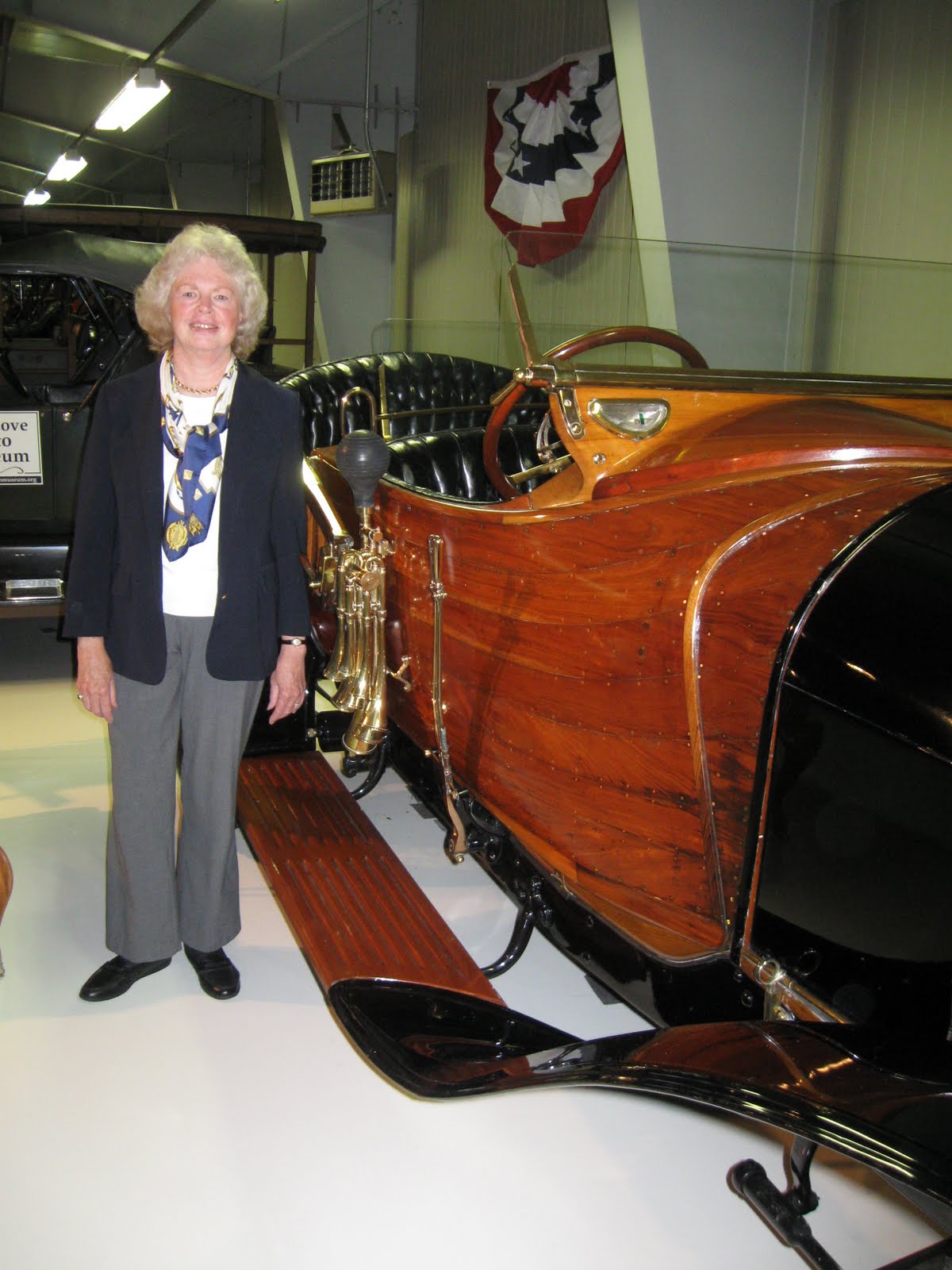
I did a little research of the “skiff” because I fell in love with its boat-like design. Actually I don’t remember the car from my childhood (the way I remember cars we drove frequently, like the 1907 Rolls Royce and the 1913 mercer Raceabout). Evidently the construction of skiff bodies on automobile chassis was primarily a French innovation, courtesy of Henri Labourdette Coachworks; such cars had appeared in auto races as early as 1897. The Peugeot skiff won at Indianapolis in 1913, 1916 and 1919, according to my father in his book Bright Wheels Rolling. In the book he says the car was a gift (!) from William Leeds of New York City, and “was one of the finest cars in our collection.” At some point, my father sold the car (and a number of others) to his good friend Dr. Sam Scher of Mamaroneck, New York. It was from Scher's collection that Richard Paine purchased it for the Seal Cove Museum.

I can’t help but think that this car may have been the inspiration (vision) my father had for a 13-foot mahogany-hulled, teak-decked launch for our yacht “Serenata.” The launch was christened “Irregardless,” because it took my father several tries before he found a boat builder who would construct it, saying “Irregardless of what others have told you, such a boat can be built and I will build it for you.” And he did!

Wednesday, September 15, 2010

Seal Cove Auto Museum


Last weekend I had the privilege and delight of giving a talk about The Melton Collection to a group at the Seal Cove Auto Museum on Mount Desert Island, Maine. I talked about my father’s passion for cars, how it began with his Uncle Charles’s White Touring Car, how his collection expanded, the founding of the Melton Museum in Norwalk, Connecticut, and its subsequent move to Florida, and finally the sale of the collection to Winthrop Rockefeller. (Much of this I have covered here in earlier postings...or will cover later.)

Billed as Opera Night, the event at Seal Cove also featured the playing of my father’s music, and the showing of the La Traviata segment of “Ziegfeld Follies.” It was a terrific evening, and my talk seemed to be well received by the 40 people in attendance.

The Seal Cove Museum itself is a fascinating collection of brass era cars. Among many highlights of the collection is the 1913 Peugeot Labourdette “Skiff” (so called because of its boat-tail design crafted of tulip wood) that once belonged to my father. What a gorgeous vehicle! It stuns me that even fifty years after my father’s death, the provenance of having been in the James Melton Collection provides value to antique cars.

Other high points of the weekend were being wined and dined by the charming Roberto Rodriguez, Executive Director of the Museum, and meeting Tina Paine Weeks, daughter of the museum’s founder, Richard Paine. Check out the museum at www.sealcoveautomuseum.org. The story behind the museum’s founding is as interesting as the cars its collection.


Margo and the 1913 Peugeot

Tuesday, August 31, 2010

A visit to San Simeon


William Randolph Hearst and Mrs. James Melton

Recently on CBS’s “Sunday Morning” program there was a segment devoted to William Randolph Hearst‘s Castle at San Simeon. My parents were guests at San Simeon in 1935, when my father was in Hollywood under contract to Warner Brothers. Marion Davies, Hearst’s constant companion, was also on the Warner lot. And so the Meltons were invited for the weekend.

They were flown up from Burbank in Hearst’s private plane, then driven up the miles-long driveway, past all manner of wild animal (zebra, antelope, giraffe). The next day my mother went horseback riding (with size six boots and perfectly-fitting riding habit provided by Hearst). Afterwards, they swam in the indoor pool, whose ceiling, walls and floors were a mosaic of cobalt blue tiles set in gold. It was like an Italian grotto, small bridges curved over it, shadowed corners drew swimmers into blue twilight depths. Lunch was at a long refectory table, punctuated by pedestaled silver dishes, alongside which were unadorned condiment bottles—French's mustard, Heinz ketchup. Next to the exquisite blue willow pattern china lay paper napkins. (Quirky guy, that Hearst!) The dining room was a 14th century monastery hall, transported from England piece by piece and reassembled. Rich oak panels rose to the vaulted ceiling from which hung brilliant flags of the early Crusaders. The table could seat fifty people.

My mother’s descriptions of their several days of lavish living seemed unbelievable until I visited San Simeon myself about ten years ago. It was everything she said, and more, and I tried to visualize my young parents in this fabulous fairyland.

By the way, the few photos from this adventure were taken with a little old Brownie camera (such as the one my mother is holding behind her back in the photo), and are tiny 1”x 2”. Not the usual celebrity 8” x 10” glossies, that’s for sure.


The outdoor pool at San Simeon


Monday, August 23, 2010

Pierce-Arrows


1918 Pierce Arrow 7-Passenger Touring Car

Last Saturday night I was privileged to speak about the James Melton Antique Car Collection at the 25th anniversary dinner of the Pierce-Arrow Society (New England Region). One of the highlights of the evening—and there were many— was meeting John Walsh, the current owner of a 1918 7-passenger Touring Car that once belonged to my father. They gave me a framed photograph of the car and a summary of its history. Some highlights of that history: Although we don’t know exactly when James Melton bought the car from Sam Adelman’s salvage yard in the Bronx, we do know that the it was used as the Press Car for the 1946 Revival of the Glidden Tour, which my father orchestrated. The car was driven on the Tour by his friend, Arthur K. Watson, of the IBM family. In 1951, the car was sold to George French in Pennsylvania, and the Walshes purchased it from him in 1996. In 2001, at the Pierce-Arrow 100th Anniversary gathering it won a First in Class Award.

As I said in my talk last weekend, I’m amazed that fifty years after my father’s death, the provenance of having been in the James Melton collection provides value to those cars.

Below is another Pierce-Arrow from my father’s collection, a 1912 Vestibuled Sedan. Wonder where it is now.


Monday, August 16, 2010

Lillian Murphy


Another young singer whose career my father helped launch was 18-year old Lillian Murphy of Kansas City. Remembering his influence on her life and career sixty years later she said, “That ‘Harvest of Stars’ broadcast on March 7, 1948 was the first day of the rest of my life. Jim sent me to New York, put me in touch with friends and professional colleagues, and got me a contract for guest appearances with him on ‘Harvest of Stars’ the following summer.” Lillian went on to sing in opera, concerts and on radio, including “The Chicago Theater of the Air,” whose auditions were handled by my father’s former Revelers colleague, Lewis James. Later, she married singer Earl Sauvain, and they are still living happily ever after in New Jersey.